


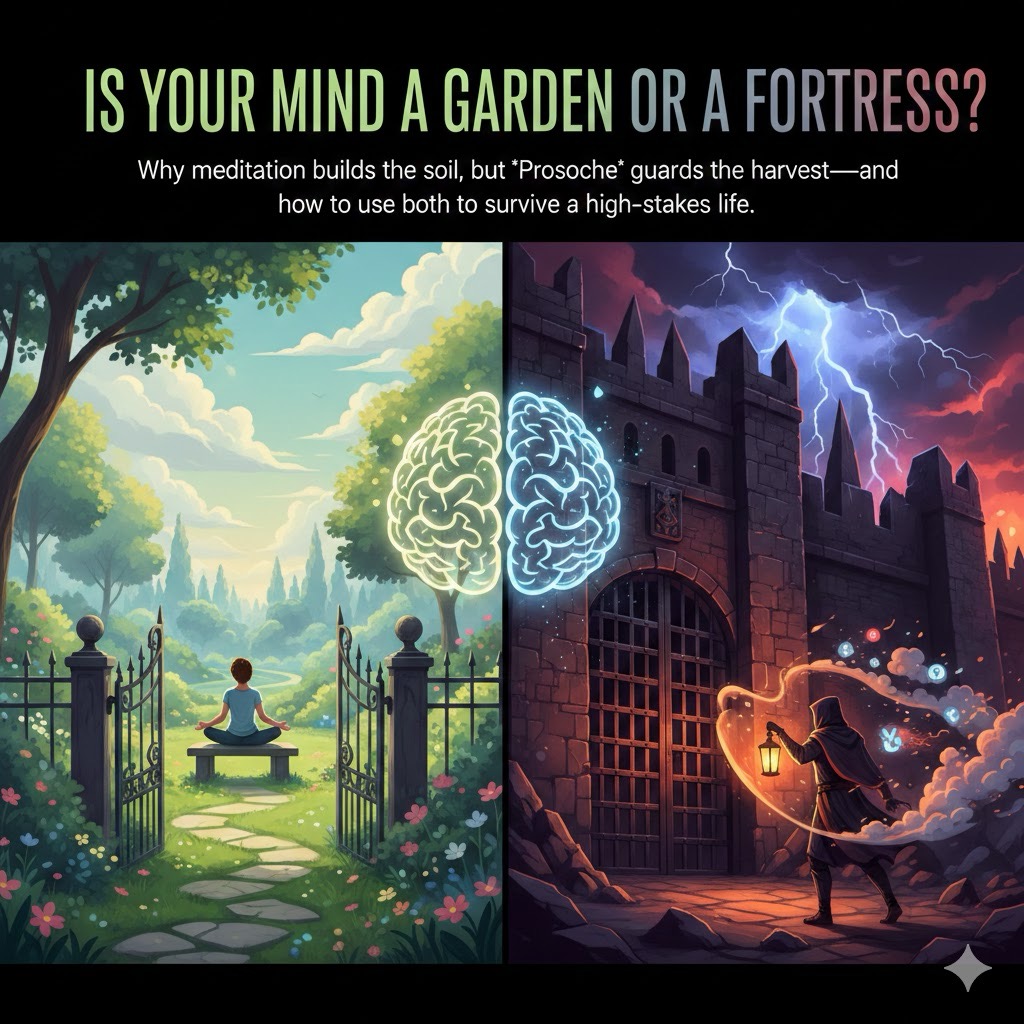
Why Meditation Isn’t Enough to Protect Your Attention
I am currently sitting in the middle of a “Triple-Threat” year—and then some.
As I write this, I am juggling the strategic expansion of a non-profit (Prescott Meals on Wheels), guiding MBA students through the high-stakes world of marketing at Western Governors University, and managing the sale of my custom home. Simultaneously, I am publishing daily on Medium and Substack while wrestling three separate book manuscripts through the labyrinth of marketing and publishing.
Most people look at a schedule like that and ask, “How do you find time to breathe?”
For years, my answer was simple: Meditation. I’ve been a vocal supporter of mindfulness. I practice meditation daily. I believe in the power of the “breath.” But recently, I hit a wall. I realized that meditating for twenty minutes didn’t protect me when a mortgage negotiation stalled at 2:00 PM or when a book launch didn’t hit the numbers I predicted.
Mindfulness taught me how to be calm in the storm. But it didn’t teach me how to navigate the storm.
For that, I had to rediscover a “lost” Stoic principle that is rarely discussed in modern self-help circles, but has the power to turn your mind into an unbreachable fortress. They called it Prosoche.
The Missing Gear: Prosoche (Stoic Mindfulness)
In 2026, the word “mindfulness” had become synonymous with relaxation. We use it to “de-stress.” But for the Roman Emperor Marcus Aurelius or the slave-turned-teacher Epictetus, attention wasn’t for relaxation. It was for war.
Prosoche (pronounced pro-so-kay) is the state of continuous, watchful attention. While standard mindfulness is often about passive observation—watching your thoughts like clouds—Prosoche is about active gatekeeping.
It is the realization that your only true property in this life is your prohairesis—your faculty of choice.
When you are juggling multiple professional roles, your attention is your most valuable currency. If you let it slip for a moment—to a negative comment on social media or a technical glitch—you aren’t just “distracted.” You have literally given away your freedom.
“Keep a tight rein on your attention,” Epictetus warned. “For if you let it slip for a moment, you will not be able to pull it back whenever you wish.”
The 2026 Research: Why Meditation Isn’t Enough
We now have the data to prove that the Stoics were right. Preliminary findings from Stoic Week 2026 revealed a striking “Stoic Zest” effect. While daily meditation alone provides a significant boost to well-being, those who coupled meditation with the Stoic practice of Prosoche saw a nearly full standard deviation increase in their “Subjective Vitality” scores.
The research suggests that meditation builds the “muscle” of awareness, but Prosoche provides the “operating system.” Meditation prepares the soil; Prosoche guards the harvest.
The “Gatekeeper” Protocol
How do you actually practice Prosoche when your life feels like a chaotic spreadsheet? I’ve developed three specific protocols to manage my roles as a leader, teacher, and writer:
1. The Objective Redescription of Chaos
The Stoics were masters of stripping things of their emotional “varnish.” When I’m managing a non-profit board and a conflict arises, I use Prosoche to redescribe the event. It isn’t a “disastrous meeting.” It is “six people in a room expressing differing viewpoints on a budget.” By stripping the adjectives, I remove the heat.
2. The “Pre-Mortem” of the Attention Sieve
Every morning, I perform a Prementatio Malorum (The Morning Forecast) of my attention. I identify exactly where my Prosoche is likely to fail—whether it’s a tech issue with KDP or a grading deadline. I decide now that these will be handled with “clinical indifference.” I am not trying to be calm; I am guarding the gate.
3. The Physical Anchor
I treat my writing like a laboratory for Prosoche. If I am writing a post, I am only writing that post. If my mind drifts to the non-profit’s facility expansion, I treat it as an unauthorized intruder at the gate. I say—internally—“Not now. You don’t have the password.”
From Busy to Vigilant
Juggling multiple projects doesn’t have to be a source of anxiety. In fact, it can be a source of deep joy if you realize that the chaos is simply “material” for your practice.


