


We don’t burn out from the work we do; we burn out from the work we think about doing. Here is how the Stoic discipline of ‘Immediate Action’ can dissolve the illusion of urgency and reclaim your 2026
I remember sitting in a glass-walled conference room while on a campus a couple of years ago, staring at a color-coded calendar that looked like a digital panic attack. My chest was tight, my coffee was cold, and I had spent the last forty-five minutes “optimizing” my task list instead of starting the first one.
I was busy, but I wasn’t productive. I was “pre-living” the stress of a deadline that was still six hours away. I had fallen into the modern trap of meta-work: the exhausting habit of thinking about work rather than simply doing it.
As we stand on the threshold of a New Year, our collective instinct is to accumulate. We buy planners, download apps, and stack our calendars with ambitious resolutions. We think that by mapping out our future, we are securing our success. But there is a profound psychological friction that occurs when we bridge the gap between planning and acting.
The truth is captured in a single, uncomfortable statement:
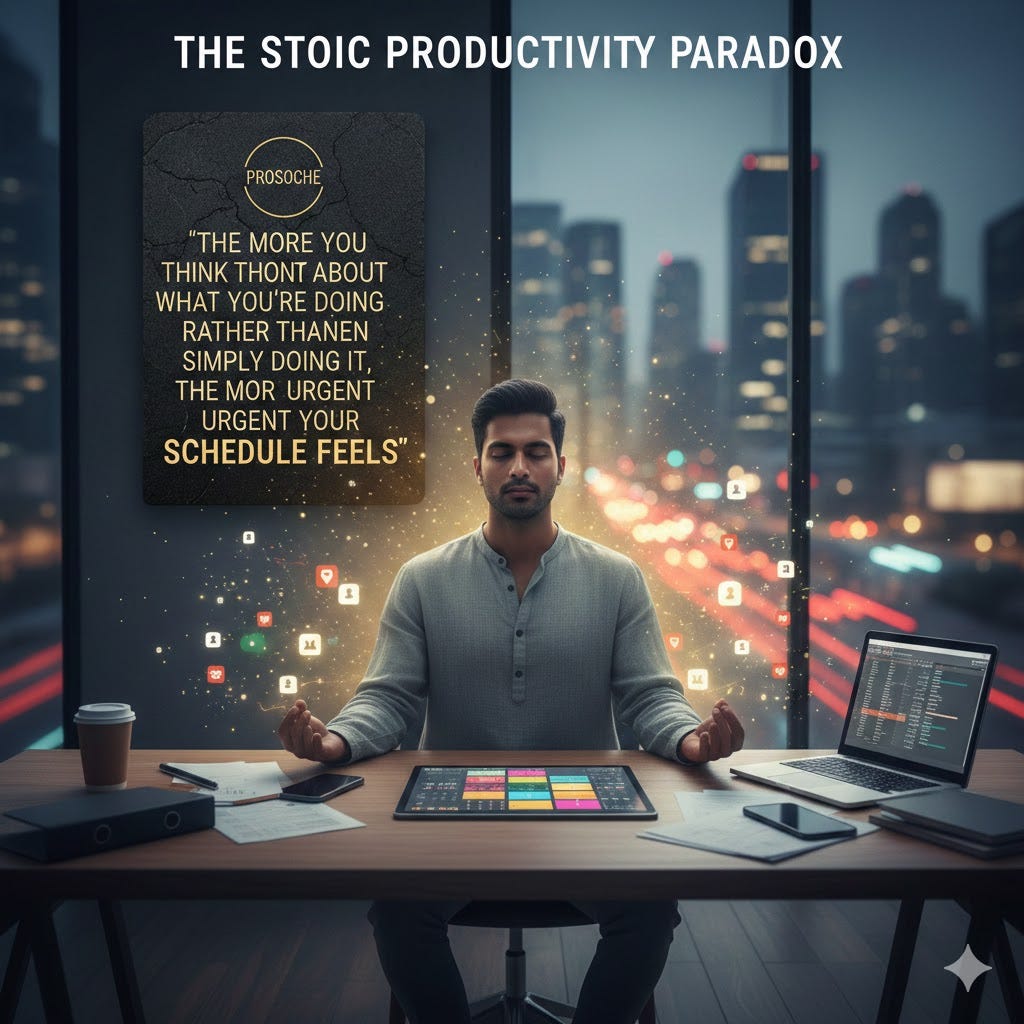
“The more you think about what you’re doing rather than simply doing it, the more urgent your schedule feels.”
To a Stoic, urgency isn’t a byproduct of a heavy workload; it is a symptom of a mind that has wandered into a future it cannot yet control.
The “Imagination Tax” of the New Year
We often treat our future selves like pack mules. We load our January schedules with “idealized” versions of work, but when the reality of Monday morning hits, we realize we’ve created a mental monster.
Psychologists call this Anticipatory Anxiety. Research suggests that the brain often cannot distinguish between a real threat and an imagined stressor. When you “think” about your daunting 2026 schedule, your sympathetic nervous system triggers a low-grade fight-or-flight response.
By the time you actually sit down to work, you are already cognitively bankrupt. You’ve used your “focus fuel” on a simulation. As the Stoic philosopher Seneca famously wrote:
“We suffer more often in imagination than in reality.”
The Stoic Solution: The Discipline of Immediate Action
The Stoics were the original masters of the “Just Do It” philosophy, but with a deeper metaphysical twist. Marcus Aurelius, who managed the Roman Empire during a plague and a border war, didn’t have the luxury of “feeling overwhelmed.” His secret was a brutal narrowing of the horizon:
“Concentrate every minute like a Roman — like a man — on doing what’s in front of you with precise and genuine seriousness, tenderly, willingly, with justice.”
To make this your most effective year yet, you must move from “thinking” to “being” using these three Stoic shifts:
The Dichotomy of Control (Schedule Edition)
Most of our urgency comes from “Uncontrollables”: Will people like my work? Will I hit my year-end target? Stoicism teaches us to divide our focus. The “Schedule” is an external — it belongs to the world. The “Action” is an internal — it belongs to you. When you focus only on the integrity of the current minute, the feeling of urgency evaporates.
Close the “Open Loops”
Modern psychology calls this the Zeigarnik Effect: our brains are hardwired to obsess over unfinished tasks, creating a “mental hum” of anxiety.
- The Practice: Stop “planning to be productive.” Commit to the Five-Minute Entry. Open the document. Write one sentence. Once the action begins, the brain stops flagging the task as a threat and starts processing it as a reality.
Amor Fati (Love of the Work)
When we look at a crowded New Year calendar, we often do so with resentment. This resistance is the primary source of our exhaustion. Amor Fati is the Stoic practice of loving whatever is in front of you. If the task is tedious, love the discipline it builds. When you stop fighting your schedule and start accepting the immediate requirement of the moment, time seems to expand.
The Bottom Line: Live Immediately
The greatest thief of your peace is “tomorrow.” We spend today’s energy worrying about tomorrow’s problems, leaving us with a tomorrow that is twice as hard because we are too tired to face it.
Seneca’s advice was simple: “The whole future lies in uncertainty: live immediately.”
Your 2026 schedule is not your enemy. Your judgment of that schedule is. The next time the weight of your “to-dos” feels like a physical pressure on your chest, realize it is a signal that you are thinking too much and doing too little.
Close the tabs. Silence the notifications. Pick the one thing you’ve been dreading most. Stop thinking, and start being.
What is the one task you’ve been “thinking about” for over a week? Commit to doing just 5 minutes of it right now, then leave a comment below and tell me how the “urgency” shifted.
About the Author
I am a #1 international best-selling author and coach obsessed with helping you live with clarity and purpose. My work blends psychology, leadership, and heartfelt storytelling to help you slow down and reclaim your focus.
Whether I am writing books like The Magic of a Moment and Embracing Retirement, or speaking on stage, my goal is the same: to help you design a life that reflects who you truly want to become. Join me as we learn to notice the moments, choose intentional action, and step into the life we were meant to live.
Connect with me and discover more at garyfretwell.com.


