


I bought the planners. I did the 15-step morning routines. Here is why they failed, and the 4 biological secrets that finally set me free.
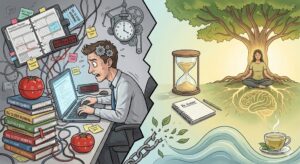
I spent 20 years stuck on the left side of this image. Here is how I finally moved to the right.
I have spent almost my entire conscious life in search of the “Holy Grail” of productivity.
If there was a system, I bought it. If there was a hack, I tried it.
I carried the heavy, leather-bound Franklin Planners. I lived my life in 25-minute bursts thanks to the Pomodoro technique. At one point, I had honed a morning routine that consisted of 15 different steps—including hydration protocols, gratitude journaling, and meditation—all before I had even opened my laptop.
But after years of optimizing my life down to the minute, I came to a startling realization: I wasn’t actually getting more productive. I was just making my life more complicated.
I was spending more energy managing my system of work than I was on the work itself.
I realized I was trying to run a human being like a computer processor. I was trying to code my behavior. But humans aren’t machines; we are biological organisms driven by hormones, emotions, and rhythms.
When I stopped looking for “hacks” and started looking at neurobiology and ancient philosophy, everything changed. I abandoned the complex planners and discovered four truths that most people never talk about.
Here are the 4 secrets to productivity that aren’t about time management, but about biology management.
1. The “Default Mode” Secret (Why You Need to Be Bored)
The Myth: If you aren’t focusing, you aren’t working. The Truth: Your brain solves its hardest problems when you stop trying.
For years, I felt guilty the moment my mind wandered. I thought daydreaming was a sin against productivity.
But neuroscientists have discovered a network in the brain called the Default Mode Network (DMN). This network activates only when you stop focusing on specific tasks. When you are staring out a window, folding laundry, or walking without a podcast, your DMN lights up.
This network is responsible for connecting disparate ideas, retrieving long-term memories, and creative problem-solving. This is why you get your best ideas in the shower, not while staring at a spreadsheet.
Leonardo da Vinci, a man more productive than I could ever hope to be, understood this. He would often stare at his work for hours without moving a brush. When criticized, he replied:
“Men of lofty genius when they are doing the least work are most active.”
My New Rule: I stopped filling every gap in my day with phone scrolling. I schedule “unfocused time.” I let my brain go offline so the DMN can process the data I fed it earlier.
2. The 90-Minute Biological Law (Ultradian Rhythms)
The Myth: You should be disciplined enough to work for 8 hours straight. The Truth: Your biology is designed to sprint, not marathon.
I used to force myself to sit at my desk for four hours at a time, fueled by sheer will and caffeine. By 2:00 PM, I was a zombie.
We all know about Circadian Rhythms (the 24-hour sleep cycle), but I had ignored my Ultradian Rhythms.
Research pioneered by Nathaniel Kleitman suggests the human brain can only sustain high-frequency focus for roughly 90 to 120 minutes before it needs a low-frequency recovery period (about 20 minutes).
When you push past this 90-minute barrier, your body screams at you with hunger, drowsiness, and fidgeting. I used to answer this scream with coffee. That was a mistake. I was chemically overriding my body’s “cleaning cycle.”
My New Rule: I work in 90-minute sprints. When I feel the dip, I stop. I don’t check email (which is still work); I step away. It is better to have 4 hours of elite, high-frequency focus than 8 hours of low-level brain fog.
3. Procrastination is Emotional, Not Logistical
The Myth: I procrastinate because I have poor time management. The Truth: I procrastinate because I am scared.
This was the hardest pill for me to swallow. I thought I needed a better calendar.
Dr. Tim Pychyl, a leading researcher on procrastination, has shown that procrastination is not a time-management problem; it is an emotion-regulation problem.
We don’t put off the task; we put off the negative emotion associated with the task. My brain viewed a difficult project as a threat to my happiness—triggering a “flight” response that sent me straight to social media.
Trying to solve this with a Franklin Planner is like trying to fix a broken heart with a calculator.
My New Rule: When I feel the urge to delay, I stop berating myself. I ask: “What emotion am I avoiding?” Usually, it’s fear of failure. I acknowledge the fear, forgive myself, and tell myself I only have to do the task for 5 minutes.
4. Via Negativa (Productivity by Subtraction)
The Myth: To be more productive, I need to add more steps to my routine. The Truth: Excellence is achieved by removal.
My 15-step morning routine was the ultimate example of “addition bias.” I thought if I added more “good things” to my day, I would be better.
But there is a concept in theology and philosophy called Via Negativa—describing God by what He is not. In productivity, this is the art of elimination.
The most productive people don’t do more things; they aggressively refuse to do unimportant things.
Bruce Lee applied this to martial arts, and it applies to our work:
“It is not a daily increase, but a daily decrease. Hack away at the unessential.”
My New Rule: I stopped making To-Do lists and started making “Not-To-Do” Lists. I cut the morning routine from 15 steps down to 3. Productivity is not about speed; it is about the absence of friction.
The Takeaway
I spent years trying to force my life into a spreadsheet. I treated myself like a machine to be optimized rather than a human to be understood.
True productivity isn’t a frantic state of activity. It is a calm state of alignment. It is the alignment of your work habits with your neurobiology, your energy cycles, and your psychology.
The secret wasn’t to work harder. It was to be more human.


